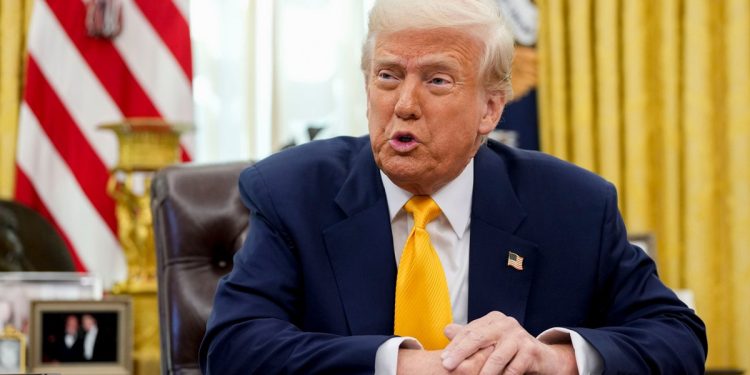

Former United States President Donald J. Trump has ordered a sweeping withdrawal of the US from dozens of international and United Nations–affiliated organisations, a move that could have far-reaching implications for Ghana and other developing countries.
The directive, contained in a memorandum dated January 7, 2026, instructs all US executive departments and agencies to immediately begin withdrawing from or halting funding to selected global bodies deemed to be “contrary to the interests of the United States.”
The decision follows an earlier Executive Order issued in February 2025, which mandated a comprehensive review of all international organisations, treaties and conventions to which the US belongs or provides financial support.
Based on the outcome of that review, the US Secretary of State, in consultation with the US Ambassador to the United Nations, identified a list of organisations considered inconsistent with US national priorities.
After reviewing the report and consulting his Cabinet, Mr Trump directed a complete withdrawal or cessation of participation and funding, subject to US law.
Non-UN organisations affected
The memorandum lists 35 non-UN organisations from which the US is to withdraw. These span critical areas such as climate change, renewable energy, democracy and governance, migration, cybersecurity, culture, counterterrorism and environmental protection.
They are;
1. 24/7 Carbon-Free Energy Compact
2. Colombo Plan Council
3. Commission for Environmental Cooperation
4. Education Cannot Wait
5. European Centre of Excellence for Countering Hybrid Threats
6. Forum of European National Highway Research Laboratories
7. Freedom Online Coalition
8. Global Community Engagement and Resilience Fund
9. Global Counterterrorism Forum
10. Global Forum on Cyber Expertise
11. Global Forum on Migration and Development
12. Inter-American Institute for Global Change Research
13. Intergovernmental Forum on Mining, Minerals, Metals, and Sustainable Development
14. Intergovernmental Panel on Climate Change (IPCC)
15. Intergovernmental Science-Policy Platform on Biodiversity and Ecosystem Services
16. International Centre for the Study of the Preservation and Restoration of Cultural Property
17. International Cotton Advisory Committee
18. International Development Law Organization
19. International Energy Forum
20. International Federation of Arts Councils and Culture Agencies
21. International Institute for Democracy and Electoral Assistance
22. International Institute for Justice and the Rule of Law
23. International Lead and Zinc Study Group
24. International Renewable Energy Agency (IRENA)
25. International Solar Alliance
26. International Tropical Timber Organization
27. International Union for Conservation of Nature (IUCN)
28. Pan American Institute of Geography and History
29. Partnership for Atlantic Cooperation
30. Regional Cooperation Agreement on Combatting Piracy and Armed Robbery against Ships in Asia
31. Regional Cooperation Council
32. Renewable Energy Policy Network for the 21st Century
33. Science and Technology Center in Ukraine
34. Secretariat of the Pacific Regional Environment Programme
35. Venice Commission of the Council of Europe
UN bodies and programmes affected
In addition, the directive orders the US to cease participation in or funding for 31 United Nations entities, including major agencies and programmes that directly affect Africa and developing economies.
They include:
1. UN Department of Economic and Social Affairs
2. ECOSOC – Economic Commission for Africa (ECA)
3. ECOSOC – Economic Commission for Latin America and the Caribbean
4. ECOSOC – Economic and Social Commission for Asia and the Pacific
5. ECOSOC – Economic and Social Commission for Western Asia
6. International Law Commission
7. International Residual Mechanism for Criminal Tribunals
8. International Trade Centre
9. Office of the Special Adviser on Africa
10. Office of the Special Representative of the Secretary-General for Children in Armed Conflict
11. Office of the Special Representative of the Secretary-General on Sexual Violence in Conflict
12. Office of the Special Representative of the Secretary-General on Violence Against Children
13. Peacebuilding Commission
14. Peacebuilding Fund
15. Permanent Forum on People of African Descent
16. UN Alliance of Civilizations
17. UN Collaborative Programme on Reducing Emissions from Deforestation and Forest Degradation (REDD+)
18. UN Conference on Trade and Development (UNCTAD)
19. UN Democracy Fund
20. UN Energy
21. UN Entity for Gender Equality and the Empowerment of Women (UN Women)
22. UN Framework Convention on Climate Change (UNFCCC)
23. UN Human Settlements Programme (UN-Habitat)
24. UN Institute for Training and Research (UNITAR)
25. UN Oceans
26. UN Population Fund (UNFPA)
27. UN Register of Conventional Arms
28. UN System Chief Executives Board for Coordination
29. UN System Staff College
30. UN Water
31. UN University
For UN-related bodies, the memorandum clarifies that withdrawal will take the form of ending participation or funding “to the extent permitted by law.”
Implications for Ghana
The US withdrawal could have significant ripple effects for Ghana and other developing countries. Several of the affected organisations — including the UN Economic Commission for Africa, UNCTAD, UNFPA, UN-Habitat, UN Women, the Peacebuilding Fund and climate-related bodies like the UNFCCC and IPCC — play key roles in policy support, technical assistance, funding mobilisation and capacity building in Ghana.
Reduced US funding and engagement may constrain programme delivery, slow climate financing, weaken peacebuilding initiatives and limit support for urban development, gender equality and population health.
Analysts say Ghana and its partners may need to seek alternative funding sources, strengthen South–South cooperation, and deepen engagement with the European Union, China and multilateral development banks to fill potential gaps created by the US decision.
While the long-term impact will depend on how other donors respond, the move signals a shift in global multilateral dynamics that could reshape development cooperation frameworks affecting Ghana in the years ahead.