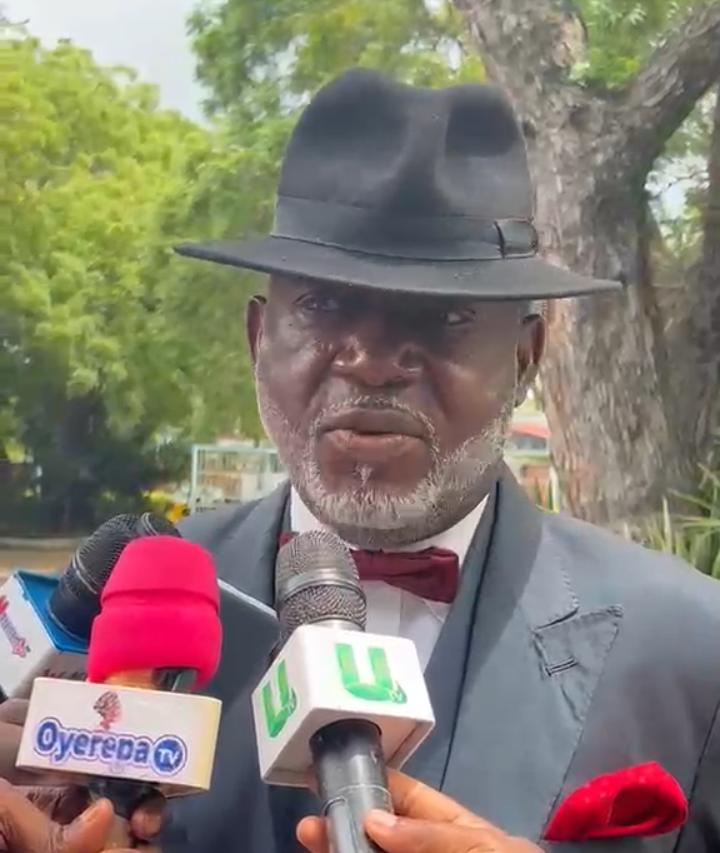

Senior legal practitioner Charles Owusu Juanah has raised a concerns regarding what he perceives as the selective criminalization of political speech within Ghana’s democratic landscape.
He firmly warns that when citizens are apprehended simply for voicing their opinions about the government, it poses a grave threat to the very foundations of democracy itself. During a recent address to the media, Owusu Juanah made his observations about the troubling trend he has witnessed, noting the “multiple arrests of people who have since shared their opinion” in the aftermath of the government's transition.
He therefore address the media today with a heavy heart, but with an unshaken commitment to constitutional democracy, the rule of law, and the sacred liberties guaranteed under the 1992 Constitution,” underscoring his deep concern for the current state of political expression in the country.
Despite his criticisms of the current government's approach towards dissent, he made it explicitly clear that he does not condone insults or personal attacks directed at the president or any public official.
He conveyed that “Leadership deserves dignity. Public office deserves decorum. Political discourse must never degenerate into vulgarity, reckless abuse, or attacks on the humanity of individuals,” emphasizing the importance of maintaining civility in political discussions
He further referred to Article 41(f) of the 1992 Constitution, alongside biblical texts, to fortify his argument that civic responsibility must be exercised “responsibly, lawfully, and respectfully,” promoting an atmosphere of constructive criticism rather than hostility.
However, he was quick to point out that for democracy to thrive, it cannot function on the basis of double standards. Owusu Juanah recalled that during the tenure of the previous NPP administration, numerous senior figures from the NDC, who are now part of the current government, had employed “highly offensive, abusive, and prohibitive language” aimed at former President Nana Akufo-Addo, Vice President Dr. Mahamudu Bawumia, as well as their families and appointees.
Yet, despite the provocative and inflammatory nature of many of these statements, he noted, “Ghana did not descend into mass arrests and systemic criminalization of political expression.” This observation served to highlight the contrasting handling of dissenting voices between administrations. He emphasized the critical importance of restraint within a democratic framework, articulating that “democracy is tested most not when government receives praises, but when government faces criticism, anger, exaggeration, provocation.”
In closing, Mr Owusu Juanah implored the authorities to remain steadfast in upholding constitutional freedoms, ensuring that mere disagreement with government policies or actions is not used as a pretext for intimidation, harassment, or unjust detention. His call for respect for civil liberties resonates as a vital reminder of the principles that underpin a truly functioning democracy, encouraging an environment where open discourse can flourish without fear of repercussions.
Sompaonline.com/ Bismarck Oppong