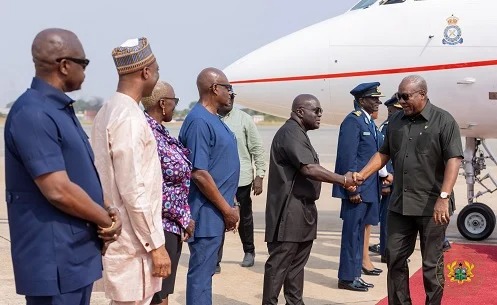

President John Dramani Mahama has directed boards of state-owned enterprises (SOEs) and public institutions to immediately halt international travel for training, conferences, retreats, and study tours funded by the state, citing growing concerns over public expenditure.
The directive, issued from the Jubilee House and signed by Secretary to the President Callistus Mahama, forms part of broader government measures to strengthen fiscal discipline and ensure the prudent management of national resources.
According to the directive dated March 5, 2026, the President’s attention had been drawn to a growing trend of international travel by boards of public institutions.
“It has come to the attention of the President that some Boards of State-Owned Enterprises (SOEs) and other public institutions have increasingly undertaken international travel for training programmes, retreats, conferences, and study tours.”
While acknowledging the value of professional exposure and continuous learning, the government said the increasing frequency and cost of such trips had raised concerns.
“While Government recognises the importance of continuous learning, exposure to international best practices, and the strengthening of corporate governance within public institutions, the frequency and cost of such international travel—often involving multiple board members and extended itineraries—have raised serious concerns regarding the prudent management of public resources.”
The statement noted that several of these trips had resulted in significant public spending.
“In several instances, such travels have resulted in significant expenditure on airfares, accommodation, per diems, and associated logistics, placing avoidable pressure on the public purse at a time when Government is implementing firm measures to ensure fiscal discipline, efficient public financial management, and the responsible utilisation of national resources.”
As a result, the President has ordered an immediate end to the practice.
“In view of the foregoing, His Excellency the President has directed that the practice whereby Boards of State-Owned Enterprises and other public institutions undertake international travel for training, retreats, conferences, or similar activities at the expense of the State should cease with immediate effect.”
The directive further instructs ministers responsible for supervising SOEs and other public institutions to ensure strict compliance.
“Boards of SOEs and public institutions shall not undertake international travel for training, retreats, conferences, or study tours funded directly or indirectly from public resources.”
However, the directive allows for exceptional circumstances where international engagements may still be considered necessary.
“Where a Board considers that an international engagement is absolutely necessary and cannot reasonably be undertaken locally or through virtual means, a formal request must be submitted through the sector Minister to the Chief of Staff at the Office of the President for the express approval of His Excellency the President before any commitments or arrangements are made.”
Any request for such approval must include a detailed justification outlining: the purpose and expected outcomes of the travel; the strategic relevance of the engagement to the mandate of the institution; the number of participants proposed; the estimated total cost; and Why the objectives cannot be achieved through local or virtual arrangements?”
The government also encouraged ministries and agencies to prioritise local capacity-building initiatives instead of foreign travel.
“Ministries and their affiliated institutions are strongly encouraged to prioritise local training programmes, in-country retreats, and partnerships with reputable local institutions, universities, professional bodies, and training institutes as cost-effective alternatives for capacity development.”
Where specialised expertise is required, institutions have been advised to rely on local or virtual engagement models.
“Where specialised training is required, institutions should also explore virtual platforms, technical exchanges, and short-term expert engagements within Ghana rather than resorting to international travel involving full Board delegations.”
The directive also emphasised that boards must focus primarily on their statutory responsibilities.
“Ministers are further requested to ensure that Boards focus their activities primarily on their statutory oversight and governance responsibilities, and that any training or capacity-building initiatives are carefully assessed for value, necessity, and cost-effectiveness.”
The government said the policy forms part of a broader strategy to control public spending and redirect resources toward national priorities.
“This directive forms part of the Government’s broader effort to strengthen expenditure controls, reduce non-essential public spending, and redirect scarce national resources toward priority programmes, infrastructure development, and social interventions that directly benefit the Ghanaian people.”
All ministers have been instructed to bring the directive to the attention of institutions under their supervision.
“Honourable Ministers are kindly requested to bring this directive to the immediate attention of all Boards, Chief Executive Officers, and management teams of State-Owned Enterprises and public institutions under their supervision, and to ensure strict compliance.”
The Presidency added that cooperation from all ministries will be essential for effective enforcement.
“The cooperation of all Ministries in enforcing this directive is highly appreciated.”
The statement concluded with formal assurances conveyed on behalf of the President.
“Please accept the assurances of the highest consideration of His Excellency John Dramani Mahama, President of the Republic.”
Sompaonline.com/Prince Atta-Boateng