

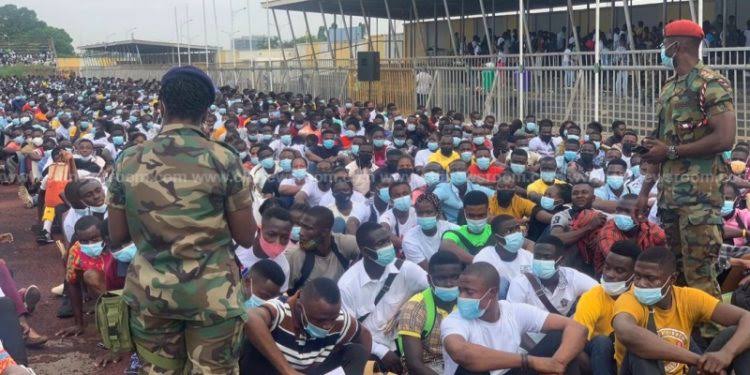

A former police officer and security analyst, Samuel Nana Appiah, has raised concerns about the transparency of the ongoing recruitment process into Ghana’s security services after hundreds of thousands of applicants purchased forms for a limited number of positions.
During parliamentary proceedings on Wednesday, March 11, the minister disclosed that although more than 105,000 applicants have progressed to the medical stage of the recruitment process, only about 5,000 positions are available across the country’s security services.
The revelation has sparked criticism from the Minority in Parliament, who argue that the government has effectively defrauded Ghanaian youth by allowing a massive number of people to purchase application forms despite the limited number of available positions.
Speaking in a telephone interview with Ama Konadu, the hostess of the Sunyani-based Sompa FM ‘Adea Akye Abia’ morning show, Mr. Appiah also criticized the administration of the recruitment exercise, saying the recruitment process in Ghana’s security services is not random and is typically guided by strict quotas approved by government authorities.
“Before any recruitment begins, the services must receive financial clearance from the Ministry of the Interior, and the Ministry of Finance will also determine the number of people each service can recruit,” he explained.
According to him, this means the security agencies are aware from the outset of the exact number of personnel they are permitted to recruit.
“In short, they have a quota and they know the number of people they are looking for,” he said.
A former police officer questioned why the online recruitment portal remained open long enough to allow hundreds of thousands of applications if the services were only seeking about 5,000 personnel.
“In a situation where you intend to recruit 5,000 people, the moment the applications reach around 10,000, the portal should be closed because you have already exceeded the number you can potentially recruit,” he argued.
He said most civilians are unaware of the actual recruitment quota, which often leads to overwhelming interest and mass applications.
“This creates false hope for many young people who believe a large number of recruits will be taken,” he said.
Meanwhile, he noted that many applicants often borrow money, sometimes between GH¢200 and GH¢300 to purchase recruitment forms and complete the process, hoping that the security agencies will recruit large numbers of people.
Mr. Appiah further described the situation as administratively unsound, arguing that allowing applications to reach as high as 500,000 without clear limits places unnecessary financial and emotional pressure on applicants.
“It does not make proper administrative or policy sense to allow people to go through such a hectic situation in the hope that many will be recruited,” he added.
The security analyst suggested that implementing a clear cut-off point on the recruitment portal would improve transparency and allow potential applicants to better understand their chances before paying for application forms.
“If there is a restriction on the portal, people will know when to apply and when not to apply. That will make the process more transparent,” he said.
The recruitment exercise, which covers multiple agencies under the Interior Ministry, continues to attract significant public attention as thousands of hopeful applicants await the next stage of the selection process.
Sompaonline.com/Derrick Djan









 Sompaonline.com offers its reading audience with a comprehensive online source for up-to-the-minute news about politics, business, entertainment and other issues in Ghana